Progress Doesn't Happen by Itself
It is easy to talk about progress like it is a weather pattern.
Technology gets better. Science advances. Innovation happens. The future arrives.
But none of that is automatic.
Progress is not some background process running on its own while everybody else gets on with life. Better tools, better medicine, better software, better rockets, better machines, better anything only show up because real people decide to spend a ridiculous amount of time and energy making them happen.
That part gets flattened when we talk about history. We remember the headline. We forget the years of study, the long meetings, the failed tests, the boring documentation, the broken prototypes, the exhausted families, the missed weekends, and the people who kept showing up anyway.
When people ask, “Why didn’t we go back to the moon?” it can sound like progress just stopped.
It did not stop.
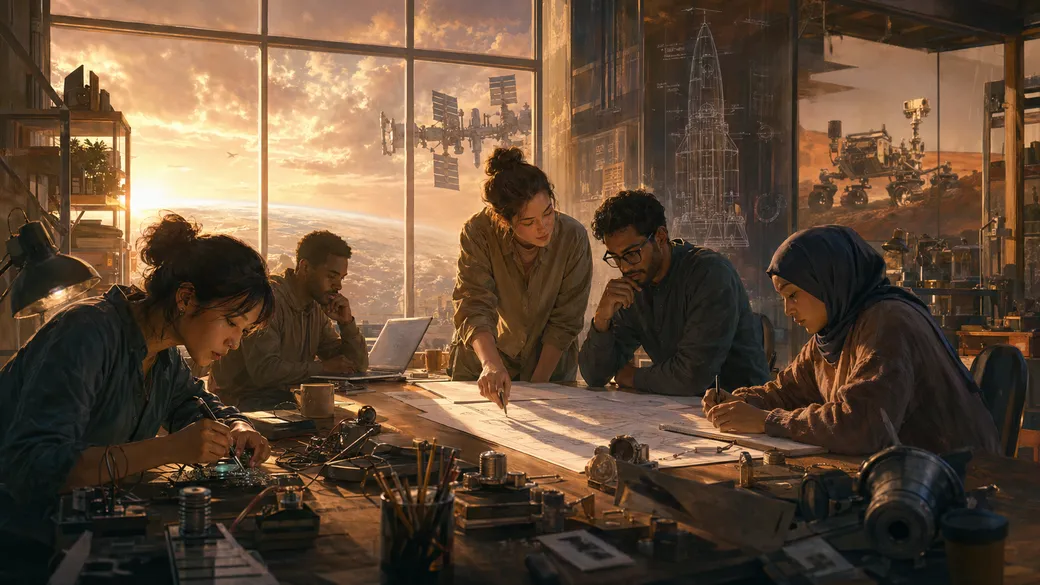
The smart people were busy building a freaking space station. They were designing robotic spacecraft that landed on Mars. They were putting telescopes in space, maintaining satellites, improving launch systems, studying Earth, building computers, writing software, and solving thousands of problems most of us will never even hear about.
That is not a lack of progress. That is progress pointed in a bunch of different directions.
And that is the point: progress has a direction because people give it one.
There is no law of nature that says rockets get safer, computers get faster, bridges get stronger, or diseases get easier to treat. Those things happen when educated, disciplined, curious people decide the work is worth doing. They happen when someone takes the time to learn the math, run the experiment, read the manual, write the code, check the work, and try again after the first version fails.
We do ourselves a disservice when we act like innovation is inevitable. It makes the work invisible. It makes it feel like the next amazing thing will arrive whether we invest in people or not.
It will not.
The future depends on whether we are willing to build the kind of people who can build it. That means education matters. Training matters. Mentorship matters. Funding matters. Culture matters. Families and communities that encourage kids to be curious matter. Workplaces that give people room to solve hard problems matter.
It also means people have to think seriously about what they are giving their lives to.
Choosing a career cannot only be about what will make the most money. Money matters. Providing for your family matters. But if the only question is, “What can I do to get rich?” then we should not be surprised when fewer people are prepared to work on the problems that actually need solving.
We need people learning things that matter. We need people spending their time on work that heals, builds, repairs, teaches, protects, and creates. We need people who are willing to aim their ability at making the world more like it should be.
Christians pray, “Your kingdom come, your will be done, on earth as it is in heaven.” If we really believe what we are praying, then “bring heaven to earth” cannot just be a nice phrase. It has to shape what we study, what we build, what we fund, and what we encourage our kids to become.
And yes, it also takes blood, sweat, and tears.
Amazing things happen because people choose to become capable, then choose to use that capability on problems that matter. They study longer than they feel like studying. They work through confusion. They become useful. They join teams. They carry tiny pieces of giant projects until, one day, the world calls the result “progress.”
We need more of that.
Not more passive belief that technology will magically improve itself. Not more cynicism that nothing impressive is happening because the exact milestone we imagined has not happened yet.
We need more people who are educated, serious, curious, and willing to put in the work.
Progress does not happen by itself.
Somebody has to make it happen.